
Planning permission and noise for an air to air heat pump
An outdoor unit at a house needs no planning permission when it meets Class 2(d) of the exempted development rules: no more than 2.5 m² of units in all, at least 50 cm from the edge of the wall or roof it is fixed to, clear of the public road, and no louder than 43 dB(A) at the nearest neighbouring home. The exemption is written for a house, not an apartment.
When the outdoor unit needs no planning permission, what changed in 2026, the noise limit, and where apartments stand.
Free and no obligation. Your request goes to one installer in your county, not a list.
- 2.5 m²of outdoor units at most
- 50 cmfrom the edge of the wall or roof
- 43 dB(A)at the nearest neighbouring home
- Front or backthe unit can go on either wall
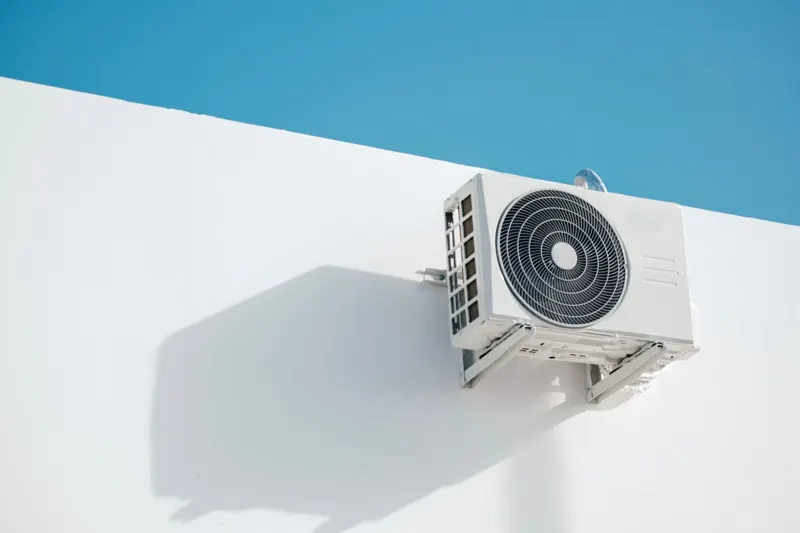
The five conditions
Class 2(d) of the exempted development regulations covers an air source heat pump on or within the curtilage of a house. The outdoor unit of an air to air system is one. It needs no planning permission when all five of these hold:
- Ground level. Not raised or lowered by more than 1 metre against the ground beside it.
- 2.5 m² at most. The area of the heat pump, taken together with any other one already at the house.
- 50 cm from the edges. The unit sits at least that far from any edge of the wall or roof it is fixed to.
- Clear of the public road. The unit must not encroach onto a public road.
- 43 dB(A). In normal running, measured from the nearest neighbouring home, or 5 dB(A) above the background noise if that is the higher figure.
What changed in 2026
S.I. No. 342 of 2026 replaced the old condition that kept a heat pump off the front wall or roof of a house. The exemption now reaches the front of the house too. The new condition is only that the unit does not encroach onto a public road.
That helps a terrace or a semi-detached house whose back wall is short, or whose garden is reached only through the house.
Price your system
Three taps and the price shows as you go. Your name and number come last, and only if you want an installer to price it.
An open-plan room or extension, one indoor unit, heating still to confirm: €2,500 to €4,000.
How the price is worked out
The figure is what Irish installers charge for the whole job, supplied and fitted: the indoor and outdoor units, the pipes between them, the electrical connection and the fitting. One room uses the single-room range, or the large-room range for an open-plan room or an extension. Two rooms, and three to five rooms, are multi split ranges. Ducted systems and rooms still to count read priced on a visit. What heats the home now changes the grant line, never the price. Sellers differ on VAT, so ask whether it is in the figure. Use it to plan with. It isn't a quote: an installer prices yours after seeing the rooms and the walls.
The noise limit in practice
The limit is 43 dB(A) in normal running, measured from the nearest neighbouring home, not from your own garden. Where the background noise is already high, the limit is 5 dB(A) above it. Distance and a wall between the unit and the neighbour do most of the work, which is why a unit tucked behind a return or set back from the boundary passes where one under the neighbour's window might not.
Ask for the sound figures of the outdoor unit from the maker's data sheet, and ask where the installer plans to put it in relation to the nearest house.
Where the installer should put it
- Away from doors and bedroom windows. SEAI's installation standard puts the outdoor unit away from the front door and from opening windows of rooms where noise matters.
- Room to breathe. The maker's clearances round the unit, so air flows in and out freely.
- Anti-vibration mounts. A wall bracket with dampers when the unit is fixed to the house, so the hum does not travel through the wall.
- Somewhere for water to go. In cold weather the outdoor unit defrosts and drips. A drain or a gravel bed under it keeps the ground from getting wet.
Apartments
The exemption is written for a house. An apartment is not covered by it, so ask the council's planning office whether an outdoor unit on your balcony, wall or roof needs permission before anything is fixed. The outside walls and roof of a block are shared, so ask the management company in writing too, and keep its answer. Apartments.
Protected structures
If the house is a protected structure, ask the council before anything is fixed to it. The same goes where the house's own planning permission carries a condition about changes to the outside.
Questions before you buy
Do I need planning permission for an air to air heat pump?
An outdoor unit at a house needs no planning permission when it meets Class 2(d) of the exempted development rules: no more than 2.5 m² of units in all, at least 50 cm from the edge of the wall or roof it is fixed to, clear of the public road, and no louder than 43 dB(A) at the nearest neighbouring home. The exemption is written for a house, not an apartment.
Can the outdoor unit go on the front of the house?
Yes, at a house, since S.I. No. 342 of 2026, as long as it does not encroach onto a public road and meets the other conditions.
What is the noise limit?
43 dB(A) in normal running, measured from the nearest neighbouring home, or 5 dB(A) above the background noise if that is higher.
How big can the outdoor unit be?
All the heat pump units at the house together can cover no more than 2.5 m².
Does the exemption cover apartments?
No. It is written for a house. Ask the council and the management company before a unit goes on an apartment block.
How far from the edge of the wall?
At least 50 cm from any edge of the wall or roof the unit is fixed to.
Everything on this site
Systems and spaces
Costs, grant and rules
See the price before anyone rings
Pick the space, the number of rooms and what heats it now. When you want a firm price, it goes to a single installer in your county.